

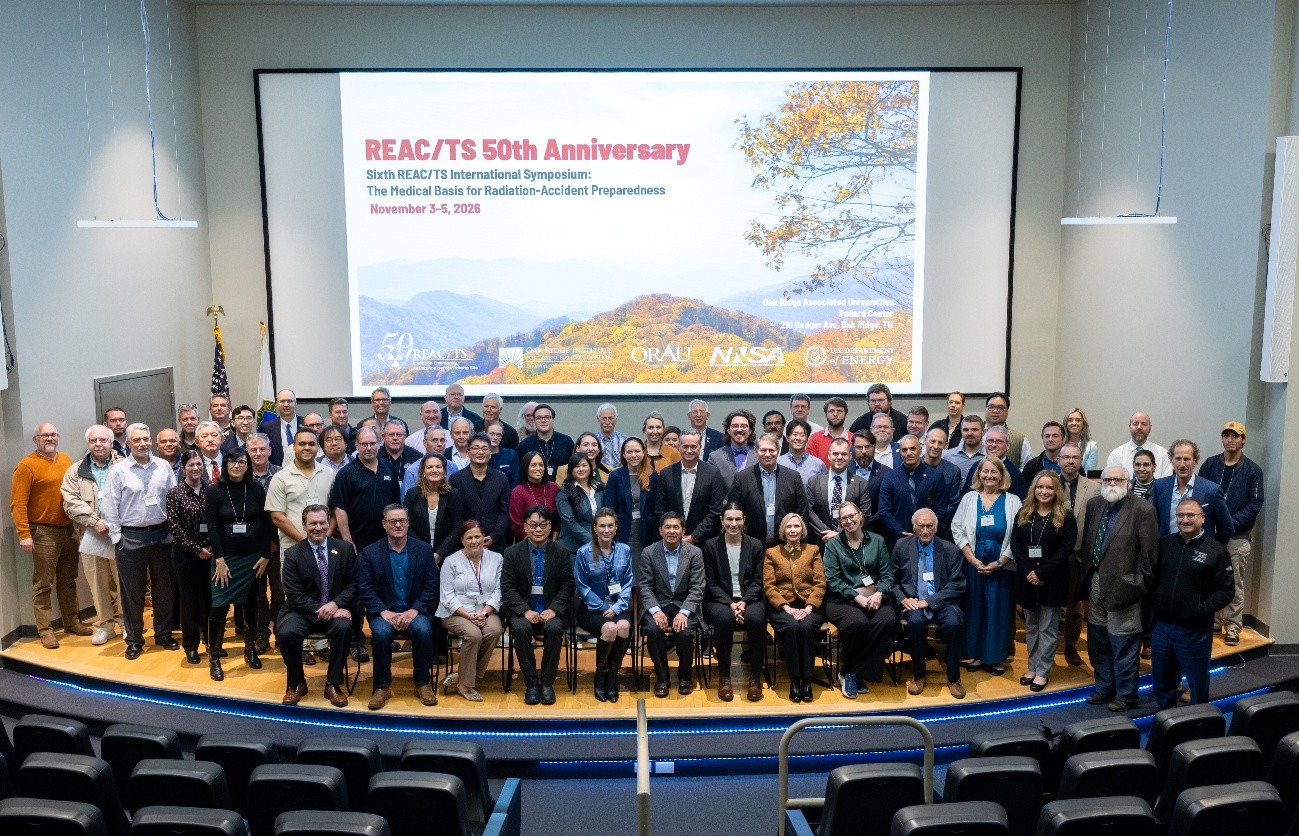
Radiological Protection, Biodosimetry and Scientific Innovation Take Centre Stage at the 50th Anniversary of REAC/TS in the United States, with Spanish Participation
Spanish researcher Alegría Montoro Pastor, Head of the Biological Dosimetry Laboratory at Hospital Universitari i Politècnic La Fe in Valencia, participated as the only invited Spanish speaker at this leading international meeting on radiological and nuclear emergencies.
From 3 to 5 November 2026, the international symposium commemorating the 50th anniversary of the Radiation Emergency Assistance Center/Training Site (REAC/TS) was held in Oak Ridge, Tennessee, United States, within the framework of Oak Ridge Associated Universities (ORAU). Over five decades, REAC/TS has established itself as an international reference centre for medical assistance, specialised training and scientific support in radiological and nuclear incidents and emergencies.
The meeting brought together specialists from international organisations, healthcare institutions, universities, research centres, regulatory authorities and emergency response organisations to review lessons learned from decades of experience and examine future scientific, technological and healthcare challenges.
Day One: Lessons from the Past and Emerging Radiological and Nuclear Risk Scenarios
The opening day, held on 3 November, focused on radiological and nuclear risks of the past, present and future, as well as the evolution of emergency preparedness and response systems. Representatives of the International Atomic Energy Agency (IAEA) and the World Health Organization (WHO) discussed experience gained from international exercises, real incidents and conflict situations, including the healthcare response to the situation in Ukraine.
Lessons learned from Hiroshima and Nagasaki, Chernobyl and Fukushima were reviewed, highlighting events that have decisively contributed to the development of modern radiological protection, health surveillance and emergency response protocols.
Particular attention was given to sessions addressing the effects of prolonged exposure to low doses of radiation, epidemiological studies involving cohorts of exposed workers, and findings from historical research on internal exposure to radionuclides such as plutonium, uranium and radium. The programme also addressed disaster medicine, prehospital medical intervention in mass-casualty incidents, and strategies to protect the population in the event of potential nuclear detonations.
These presentations highlighted the need to integrate scientific knowledge of the effects of ionising radiation with effective planning, appropriate risk communication and strong coordination among authorities, emergency services and healthcare professionals.
Day Two: International Cooperation, Biodosimetry and New Medical Countermeasures
The programme on 4 November focused on strengthening international partnerships and scientific innovations in the assessment and medical management of individuals exposed to ionising radiation. The first session emphasised the importance of cooperation among healthcare institutions, radiological protection organisations, research centres and international organisations. Collaborative experiences involving toxicology centres, specialist training programmes, NATO military medicine initiatives and national radiological emergency response systems were presented.
Subsequently, the session devoted to innovations in biodosimetry and medical management provided an overview of some of the most significant advances in dose estimation and the development of new tools for medical emergency response. Topics included the use of biological biomarkers, extracellular vesicles as potential indicators of radiation exposure, electron paramagnetic resonance dosimetry, and the assessment of mixed gamma and neutron exposures. Scientific uncertainties concerning the risks associated with very low-dose exposure, the biological basis of FLASH radiotherapy, and advances in the treatment of severe radiation-induced skin injuries were also discussed.
In the field of medical countermeasures, research was presented on new decorporation agents, including oral DTPA formulations and HOPO compounds, as well as strategies promoted by the United States National Institutes of Health (NIH/NIAID) to improve medical preparedness for nuclear emergencies.
During the second day, Alegría Montoro Pastor, Head of the Biological Dosimetry Laboratory within the Radiological Protection Service at Hospital Universitari i Politècnic La Fe in Valencia, participated as the only invited Spanish speaker at the symposium. Her lecture, entitled "The Future of Radiation Emergency Medicine: AI, Biodosimetry, and Medical Countermeasures", addressed Spain's radiological emergency response capabilities, advances in biodosimetry and artificial intelligence, and the development of new medical countermeasures, with particular emphasis on radioprotectors and radiomitigators. She concluded her presentation by inviting participants to attend the IRPA17 International Congress, which will be held in Valencia in 2028.
Day Three: New Nuclear Technologies and Challenges for Radiological Protection
The final day, held on 5 November, was dedicated to technological innovations and the so-called nuclear renaissance, examining the opportunities and challenges arising from new developments in the nuclear industry. Sessions addressed advances in next-generation nuclear reactors, small modular reactors (SMRs), new laser-based isotope enrichment technologies, and nuclear applications related to space exploration.
From a radiological protection perspective, presentations on operational radiological protection in small modular reactors and new risk-informed regulatory approaches to emergency preparedness and response at advanced nuclear facilities were particularly relevant. These technologies pose new challenges for risk assessment, radiological monitoring, worker protection and emergency planning, which will need to evolve alongside industrial innovation.
Following the official closing of the symposium, a joint session on radiation and disaster medicine was held in collaboration with CBRNe World and specialists from Harvard Medical Faculty Physicians. This session examined the resources available for nuclear emergency response, medical needs following a nuclear detonation, and the potential of artificial intelligence-assisted multiparametric biodosimetry to accelerate triage and support clinical decision-making.
The programme concluded with presentations on medical countermeasures, chemical and biological threats, and hospital preparedness for CBRN (chemical, biological, radiological and nuclear) incidents, including decontamination procedures and paediatric care.

Fifty Years of Experience and a Vision for the Future
The 50th anniversary of REAC/TS highlighted that radiological protection and medical response to nuclear and radiological emergencies require an increasingly multidisciplinary approach, integrating scientific research, technological innovation, healthcare preparedness and international cooperation. Advances in biodosimetry, new applications of artificial intelligence, the development of medical countermeasures and technological changes in the nuclear industry represent some of the main challenges and opportunities for the coming years.
Spanish participation in this international meeting helps strengthen the visibility of Spain's scientific and healthcare capabilities and underscores the importance of continuing to promote international collaboration, knowledge transfer and applied research to improve the protection of workers, emergency responders and the general population in radiological and nuclear emergencies.
Spain's Contribution to the Future of Radiological Emergencies: More Than Twenty Years of Research, Innovation and Technology Transfer
Spanish participation was represented by Alegría Montoro Pastor, PhD in Biological Sciences and Head of the Biological Dosimetry Laboratory within the Radiological Protection Service at Hospital Universitari i Politècnic La Fe in Valencia, who participated as the only invited Spanish speaker at the symposium. Her lecture, entitled "The Future of Radiation Emergency Medicine: AI, Biodosimetry, and Medical Countermeasures", provided an overview of Spain's experience in radiological and nuclear emergency preparedness, as well as advances in artificial intelligence, biodosimetry and the development of new medical countermeasures.

First, she presented the capabilities of Hospital La Fe as one of Spain's two specialised centres for the medical management of irradiated and radioactively contaminated patients (CAIC), alongside Hospital General Universitario Gregorio Marañón in Madrid. She described the facilities available for contamination detection, decontamination, isolation and medical care, as well as the role of the Radiological Protection Service and the Biological Dosimetry Laboratory in emergency response. She also highlighted the ongoing collaboration with REAC/TS, including the Spanish translation of its guide on medical assistance in radiological incidents.
Within the framework of collaboration with REAC/TS, she also highlighted the specialised training undertaken by Dr Juan Gómez Ferraz, a physician from the Radiological Protection Service at Hospital La Fe, who has completed the basic and advanced courses in medical preparedness for radiological and nuclear emergency response provided by this US centre, thereby contributing to strengthening medical response capabilities for such incidents.
In the field of artificial intelligence, she presented research conducted in collaboration with researchers from the University of Málaga (scientific publication) and REAC/TS on the automated identification of dicentric chromosomes, as well as the future potential of agentic AI to improve triage, data management and response coordination, always under human supervision.
She also presented progress made within the National Biological Dosimetry Protocol, a project funded by the Spanish Nuclear Safety Council (2022–2026), which she coordinates from Hospital La Fe and involves 26 specialists from six Spanish laboratories. This initiative aims to harmonise methodologies, strengthen national dose estimation capabilities and establish coordinated procedures for responding to radiological emergencies involving multiple casualties.

From Basic Research to Clinical Application: Twenty Years Developing Radioprotectors and Radiomitigators
The final part of her presentation focused on one of the main research lines pursued for more than two decades at Hospital La Fe, in collaboration with the Universitat de València and other institutions: the development of radioprotectors and radiomitigators capable of preventing or reducing the biological effects of ionising radiation.
Montoro provided a historical overview of this research, which began in 2005 with the first studies on the radioprotective properties of propolis, leading to her doctoral thesis in 2006. Subsequently, from 2008 onwards, projects funded by the Spanish Nuclear Safety Council focused on natural compounds such as curcumin and resveratrol, resulting in numerous publications on their radioprotective effects. The research evolved from initial in vitro experiments to animal models and studies of skin absorption in ex vivo human skin, including investigations into the prevention of radiation-induced skin injuries.
A decisive advance occurred in 2017 with the beginning of a scientific collaboration with the research group led by Dr José María Estrela at the Universitat de València, focused on developing new formulations based on pterostilbene and other bioactive compounds (scientific publication). This work led to the development of a combined formulation with radioprotective activity, evaluated through different routes of administration in experimental irradiation models. The results led to the filing of a patent application in 2021 (patent WO2022152943A1), subsequently granted at the European level in 2025, and to the transfer of the technology through a licensing agreement with CIRCE Health Science.
The research subsequently focused on developing topical formulations designed to prevent and mitigate skin injuries caused by radiotherapy. Within the framework of a project funded by the Valencian Innovation Agency (AVI), an experimental cream was developed and preclinical safety and efficacy studies were conducted, including partial-body irradiation models and application of the product both before and after exposure. Knowledge transfer also enabled the development of IOVE, a commercial line of dermocosmetic products based on bioactive compounds with antioxidant and anti-senescence properties, illustrating the application of radiobiological research findings to skin care.
One of the most significant advances presented was the transition from preclinical research to evaluation in patients. A multicentre, randomised, double-blind clinical trial is currently being conducted at Hospital La Fe and Hospital Clínico Universitario de Valencia, coordinated by Dr Montoro and sponsored by Dr Estrela, to evaluate an experimental cream containing pterostilbene, silibinin and nicotinamide riboside in patients with head and neck cancer undergoing radiotherapy. The study, expected to be completed in 2026, assesses the progression of skin lesions through clinical evaluations, photographs and thermography, with the aim of determining the formulation's potential to prevent or reduce radiodermatitis.
Finally, Montoro presented the results of a preclinical study published in 2026 on a new fully oral formulation combining pterostilbene, silibinin, nicotinamide riboside and captopril (scientific publication). In animal models of total-body irradiation, this combination showed promising results, with a long-term survival rate of 90% under the experimental conditions studied and improved recovery of healthy tissues. Furthermore, studies conducted in tumour models showed that the formulation did not compromise the efficacy of radiotherapy in triple-negative breast cancer and could enhance radiosensitisation in glioblastoma models.
One of the innovative aspects of this research line is the development of formulations with both radioprotective and radiomitigating activity, meaning they could potentially be useful when administered before radiation exposure to prevent damage, and after exposure to reduce its biological consequences. This dual potential represents one of the main areas of interest in the research, particularly given the need for effective medical countermeasures in accidental exposure situations or scenarios involving multiple casualties. Although the preclinical results are promising, their efficacy and safety for these applications will need to be confirmed through additional studies.
The lecture demonstrated how a research programme initiated more than twenty years ago has evolved from early experimental studies to intellectual property protection, technology transfer, commercialisation of dermocosmetic products and clinical evaluation of new formulations.
Valencia to Host the IRPA17 International Congress in 2028
Montoro concluded her presentation by inviting participants to attend the 17th International Congress of the International Radiation Protection Association (IRPA17), which will take place in Valencia from 28 May to 2 June 2028. As a member of the international organising committee, she highlighted the opportunity this meeting will provide to bring together the scientific and professional radiological protection community, strengthen international collaborations and continue advancing the protection of people against the effects of ionising radiation.

Dra. Alegría Montoro Pastor
Original source: Sociedad Española de Protección Radiológica (SEPR)
